

Curse Of The Pharaohs Ending
The Curse Of The Pharaohs Explained
The difference between a zombie and a mummy, as well their wardrobe and mental clarity, is that while both are shuffling corpses, mummies definitely existed in history. You can go to a museum and meet one, presuming you go to the right kind of museum. Egyptian mummies are the preserved bodies of people who lived thousands of years ago, some of which are even the bodies of pharaohs and other royalty. Information technology was a process that involves removing organs, embalming the torso, and wrapping it in linen.
For hundreds of years, people have believed that disturbing the tombs of these preserved dead can bring a horrible curse upon the intruder as well every bit anyone they come in contact with. This belief spread like wildfire following the world-famous earthworks of the tomb of Tutankhamun. But what is the curse of the pharaohs? How many people has information technology affected, and what tin can be done most it? This is the curse of the pharaohs, explained.
Curses were a mensurate of tomb security for pharaohs
While you can contend whether they actually had any magical effect, the fact is that Egyptians did use curses, especially equally security measures on their tombs. As Expedition Magazine explains, these curses were more than probable to be present in the tombs of private citizens rather than royalty (presumably because royal tombs had better security), but royal curses are far from unheard of. Almost of these curses took the form of threats toward anyone who might rob or otherwise desecrate the tomb.
These curses tend to have the format of "anyone who [does something bad to my tomb], even if they [do or say a lot of things to protect themselves], will [suffer extreme penalty." An abridged example includes, "As for anyone who volition: do something evil against this my grave, seize a stone from this my tomb, remove any rock or any brick from this my tomb, enter this tomb in impurity [...] he will be judged regarding information technology by the nifty god. I volition wring his cervix similar a goose and cause those who live upon earth to fear the spirits who are in the W. I will exterminate his survivors." Yikes.
Such curses are part of a larger body of magical texts known equally execration rituals, which were meant to curse a person or object ane found unpalatable, or to ward off harmful spirits.
Pre-Tut mummy encounters
While we tin can't say for sure whether any ancient graverobbers suffered any ill effects from the cursed tombs of Egypt, the earliest known report of a mummy's expletive from the mod era is pretty unambiguous. As recorded by writer Leo Ruickbie, the beginning horrific account of a mummy'southward magical attack comes from Louis Penicher'south 1699 business relationship of a Smoothen traveler who had taken two mummies from Alexandria. The traveler was subsequently haunted by visions of twin specters who plagued his dreams and was terrified past the increasingly stormy seas on his voyage back home. Apparently, the waves grew worse and worse until the human being threw the mummies overboard, at which point the storm abated. Whether or non this story is truthful, such tales definitely increased popular intrigue around the idea of mummies presenting a supernatural threat.
Interest effectually mummies and their tombs simply increased in the Victorian era, during which period a kind of Orientalist "Egyptomania" swept the empire. In the 19th century, a macabre new fad emerged among the British leisure class: mummy unwrapping parties. While nominally done for science, these spectacles more than likely appealed to the more prurient interests of the repressed upper classes as salacious entertainment. At least this was maybe incrementally more adequate than centuries-old practice of eating mummies for their supposed medical benefits.
Opening Tutankhamun's tomb
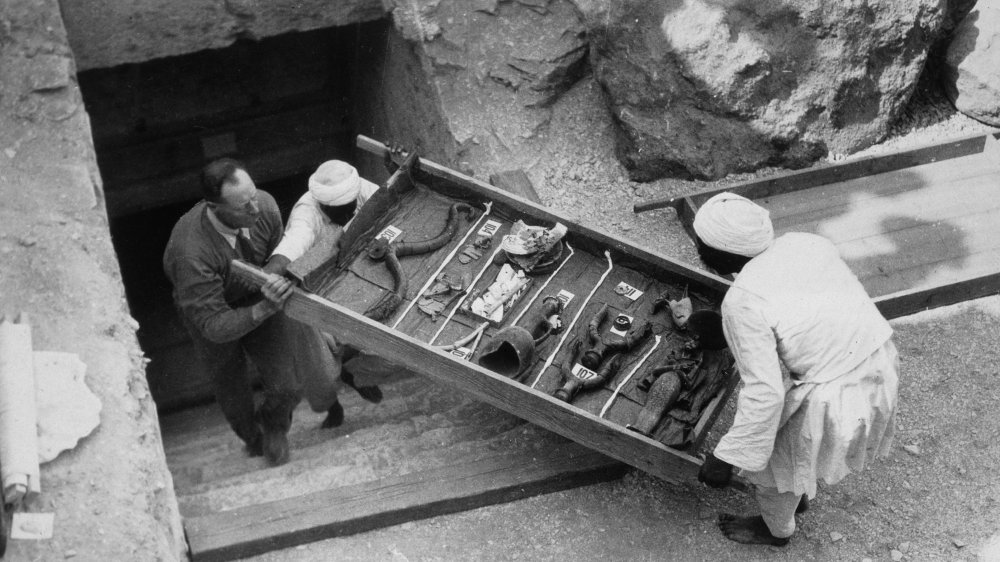
The virtually famous example of a mummy's curse — and the i that kind of drove the idea into the mainstream — is, naturally, associated with the most famous mummy who ever lived (or, uh, died and was then embalmed). According to History, on February sixteen, 1923, an trek led by British archaeologist Howard Carter and financed by Lord Carnarvon opened the sealed burying chamber of the teenaged pharaoh of the 18th dynasty, Male monarch Tutankhamun, also known as King Tut. Tutankhamun had previously been a fiddling-known and unimportant ruler as far as pharaohs go, but the discovery of his basically intact and undespoiled tomb launched him to a level of celebrity that has hardly macerated in the following century. Carter's discovery besides kicked off a whole new wave of interest in Egyptology.
It had been in Nov 1922 that Carter and company first entered the interior chambers of Tut's tomb. There they found treasures that had not been seen past human being eyes in over 3,000 years, a rarity equally the majority of pharaonic tombs had been looted in previous centuries. In the final chamber, opened in February, Carter establish the now-iconic sarcophagus of King Tut, as well as numerous jewels, statues, chariots, and articles of clothing, all of which were carefully catalogued. According to popular legend, withal, ane other matter was uncovered when the last chamber was unlocked: a deadly curse.
Tragedy strikes the Carter expedition
Despite the fact that Male monarch Tut's tomb was not an example of a tomb begetting an inscribed curse on the wall or on any item in its interior, the curse of King Tut is the most famous pharaoh's curse of them all. This was due to the mysterious deaths that befell members of that famous expedition (made even more famous because of the deaths and the alleged curse). Mental Floss lists the various members of the Carter expedition to meet an untimely end after the opening of Tut's tomb in 1923.
The first, and perhaps nigh shocking, was the dig'south financier, Lord Carnarvon, who died mere months after the tomb was offset opened when he accidentally cutting open a musquito bite that became infected. A friend of Howard Carter's, to whom he gave a mummified hand every bit a paperweight gift, had his house burn then flood when he tried to rebuild. American railroad executive George Jay Gould died of pneumonia afterward visiting the tomb.
Lord Carnarvon's half-blood brother never fifty-fifty visited the tomb, but his blindness, rotten teeth, and death past sepsis are sometimes attributed to beingness related to an accursed brother. Others supposedly died of murder by smothering, death past called-for, and suicide at despair over the curse, among others. Howard Carter himself lived for over a decade later the trek, but some even so attribute his decease from lymphoma to the curse.
Arthur Conan Doyle helped spread mummy fever
In that location are a number of people who might be credited with helping to spread the story of the curse of King Tut, as History Answers explains. One culprit was Arthur Weigall, a writer for the Daily Mail who was upset that Lord Carnarvon had sold exclusive story rights to rival newspaper The Times and began to fill columns with whatsoever Tut "facts" he could, including the story that Carnarvon's pet canary had been killed by a cobra the day the tomb was opened, which he interpreted equally an ill omen. Weigall's writing played upwards the curse angle, which he correctly anticipated the public would eat up, and he after claimed to take predicted Lord Carnarvon'due south death, saying, "If [Carnarvon] goes down [into the tomb] in that spirit, I give him six weeks to live."
Some other person to whom the spread of the curse story can be credited is Sherlock Holmes creator Sir Arthur Conan Doyle, who had a credulous fascination with the supernatural despite being best friends with professional person psychic-buster Harry Houdini. Doyle specifically told a New York newspaper that Carnarvon's death was due to an "evil elemental" conjured up by Egyptian priests to protect Tut's tomb. Doyle backed up his confidence with anecdotes about personal friends he believed had been cursed by another mummy. The existence of this mummy could not, alas, be confirmed.
Debunking the expletive of the pharaohs
While it is certainly striking to expect at a list of those who died or otherwise suffered equally a event of the alleged curse of King Tut, it may pay to wait at the circumstances with a more skeptical eye. According to History, a written report carried out in 2002 by the British Medical Journal looked closely at the survival rates of 44 Westerners who, according to Howard Carter, were in Egypt at the time the tomb was opened (only Westerners were considered equally, according to fable, native Egyptians were not affected by the curse). The deaths of the 25 men who were part of Carter's squad were compared with those of the Westerners who were not involved in opening the tomb. The study concluded that there was no significant correlation betwixt exposure to the tomb and the average historic period of death. No one who entered the tomb was more likely to die within 10 years than someone who hadn't.
While a popular theory is that the tomb may have contained mold, spores, or other toxins that infected diverse members of the team, experts mostly don't buy that idea, though mummies and tombs definitely tin contain mortiferous leaner and mold. The fact is, many of those who died had already been ill. The residue were just people looking for tenuous connections where they don't actually be.
Did a pharaoh'due south curse sink the Titanic?
Aside from the supposedly cursed tomb of Tutankhamun, i of the virtually famous stories of a mummy-fueled plague is associated with maybe the virtually famous disaster of the 20th century: the sinking of the Titanic. The story of the Unlucky Mummy, every bit it is known, says that iv young Englishmen visiting Luxor bought a mummy case containing the remains of an Egyptian princess. 1 by i, these four men are stricken with disaster: disappearing in the desert, getting shot, losing a fortune, and succumbing to disease.
Eventually, the mummy ends up in the hands of the British Museum. When placed in the Egyptian Room, the mummy began frightening night watchmen with weeping and pounding, throwing other exhibits off shelves, and cursing a kid with measles. The museum sold the mummy to a private collector, who found himself as haunted. This collector eventually agreed to ship the mummy to an American archaeologist in New York. In April 1912. On the HMS Titanic. You get it.
Is this story true? Snopes says of grade not. The Titanic's manifests have been closely studied, and there is not a unmarried mummy listed among its various contents. In fact, yous can trace dorsum the story of this cursed mummy to the writers William Stead and Douglas Murray, who were inspired by a real coffin hat at the British Museum. The legend got tied to the Titanic after Stead actually died in that tragedy.
The Curse of Osiris
Shutterstock
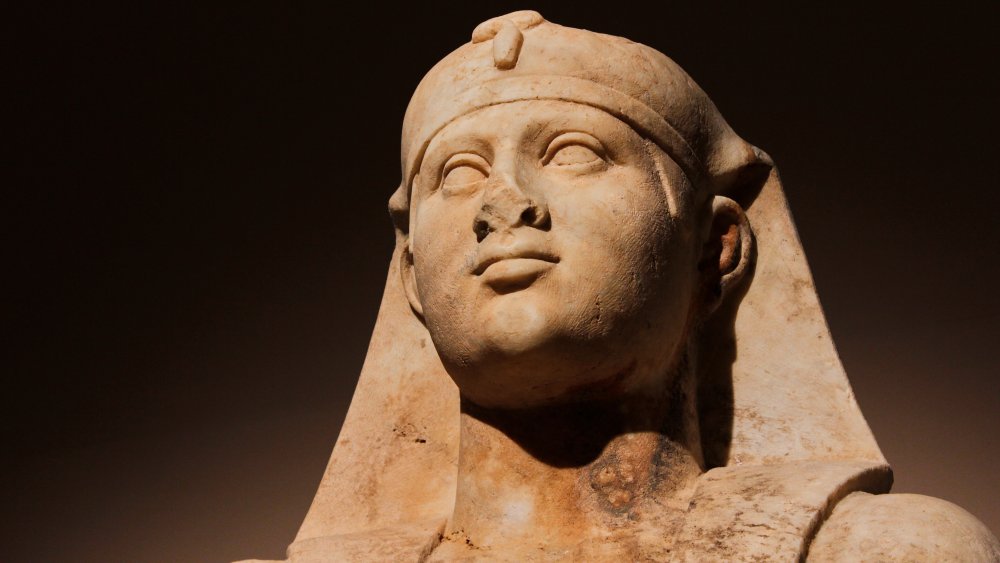
The book The Curse of the Pharaoh'southward Tombs by Paul Harrison tells the story of British Egyptologist Walter Bryan Emery following the uncovering of a subconscious tomb in Sakkara. During this digging, i of Emery's workers found a statue of the Egyptian god of the expressionless, Osiris, about eight inches long. The worker gave the statue to Emery, who took it back to his quarters. Emery set up the statue on a table and went to take a shower while his banana waited outside. Soon the assistant hears a worrisome dissonance and calls out to Emery, receiving no response. The assistant entered the bathroom and found Emery standing paralyzed in the shower. He dragged the professor to the burrow and called an ambulance.
Emery was rushed to the British hospital in Cairo, where doctors confirmed that Emery was indeed paralyzed on his correct side, unable to move or speak. His married woman Mary comforted him, merely Emery passed away the next twenty-four hours, March eleven, 1971. Cairo newspapers blamed his decease on the curse of the pharaohs. Is this story truthful? Well, Emery was a real British Egyptologist who did excavate a tomb in Sakkara, and he did uncover a small statue of Osiris. He did besides collapse all of a sudden after a stroke and dice in a Cairo hospital in March 1971. The details of the story are perhaps exaggerated to draw a connectedness between the statue and his decease, still.
The expletive of Tut returns
Heritage Images/Getty Images
The fable of the curse of King Tutankhamun, information technology seems, will never die, whether in reality if you believe in curses, or in popular imagination if you don't. Even decades after the decease of Howard Carter, people accept continued to believe that the expletive of Tut lives on. World-famous Egyptologist Zahi Hawass tells in his book The Golden Rex of a story spread by a German journalist in a book about the curse of the pharaohs from the 1970s. According to this tale, the journalist met with the Director Full general of the Egyptian Antiquities Department, Dr. Gamal Mehrez, and asked if he believed in the curse. Mehrez replied that though he had excavated many tombs and mummies, nil had ever happened to him. Co-ordinate to the journalist, Mehrez was expressionless the next solar day.
Popular fable associates Mehrez'southward decease with the movement of some of the treasures of King Tut to an exhibition in England, according to Expedition Magazine. Expedition and Hawass both bespeak out, withal, that Mehrez had long suffered from chronic illness. Hawass furthermore reveals that Mehrez actually specialized in Islamic archaeology and had, in fact, never excavated annihilation from pharaonic times. Other casual deaths have likewise been attributed to Tut's curse, including an archaeologist who was hitting past a automobile later protesting the move of some of Tut'southward treasures to France, and another director of antiquities killed while crossing the street.
The pharaoh's curse claims a life a year
Zahi Hawass is an Egyptian archaeologist and Egyptologist who was Egypt's commencement Minister of Land for Antiquities Affairs. His 2006 volume The Golden King: The World of Tutankhamun discusses his experiences with mummy curses. According to Hawass, when he was immature, he was involved in an digging in the Nile Delta. His job was transporting the excavated artifacts, near of which were from the Greco-Roman era, to Cairo's Egyptian Museum. The very same day that he moved these objects, his aunt died. The side by side yr on the twenty-four hours he moved the artifacts, his uncle died. The post-obit twelvemonth, his favorite cousin died.
Despite the annual loss of dear family unit whenever he transported ancient objects, Hawass does not believe in the curse of the pharaohs, rightly acknowledging that most of the deaths associated with Male monarch Tut were foreigners who had zippo to do with the actual excavation. Nevertheless, in his before book The Valley of the Golden Mummies, he relates the story of how after excavating the mummies of two children at the Bahariya Oasis, he establish himself haunted by the children in his dreams. Later on months of sleepless nights and a particularly frightening nightmare in which the young girl mummy reached out to strangle him, Hawass concluded that the children needed to exist displayed with their father, also a mummy. After the family unit was reunited, the nightmares stopped.
Tomb raider receives pharaonic revenge
Shutterstock
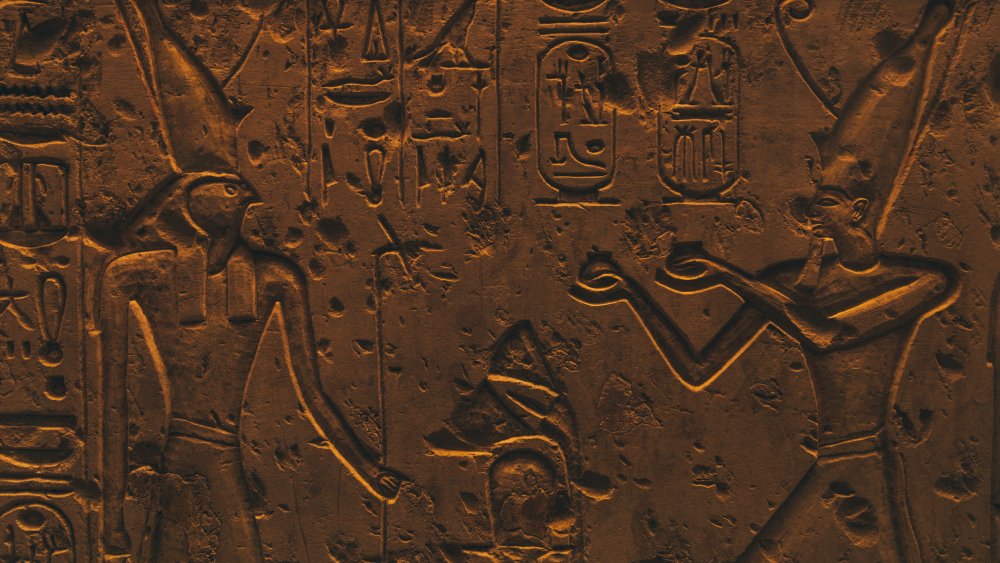
Not everyone who gets stricken with a mummy's curse is an archaeologist. In some cases, the accursed in question isn't looking to put artifacts in a museum but rather money — or a absurd trinket — in their pocket. Such was the example in 2004 when a German tourist visited an Egyptian tomb and decided to stroll out with a pharaonic carving he definitely had not walked in with. Co-ordinate to the Australian Broadcasting Corporation, one time the human being returned dwelling to Germany with his illicitly obtained souvenir, he began experiencing a number of horrific conditions, including paralysis, nausea, fevers, chills, and fifty-fifty cancer, to which he eventually succumbed by 2007.
At that betoken, the man's stepson decided the only way to rid his family of this curse was to return the object to its place of origin. Equally such, he sent the carving to the Egyptian embassy in Berlin, who sent the object back to the Supreme Council for Antiquities for hallmark. The artifact was sent along with a note from the stepson apologizing for the theft and his business relationship of his stepfather'southward death, which he attributed to the expletive of the pharaohs. According to the annotation, the stepson hoped that returning the etching would absolve for his stepfather's crime and allow his soul to rest in peace. That, presumably, is upward to Osiris.
The pharaoh'south expletive every bit genre
Getty Images/Getty Images
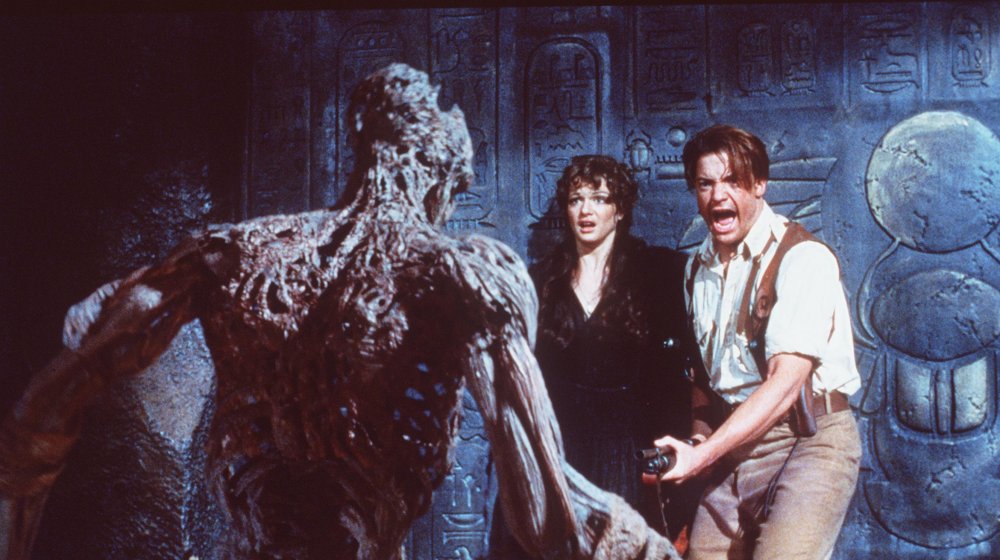
While the rumors of mummy's curses were fueled by real-life deaths and a large number of sensationalized news reports looking to sell papers, pop fiction as well played a role in the broadcasting of the idea that a mummy might impale you with magic. Sparked past the Victorian fad of Egyptomania and mummy unwrappings, a number of horror and science fiction writers started incorporating mummies and curses into their stories. In 1827, English author Jane Loudon, an early pioneer in science fiction and Gothic horror, wrote a three-volume piece of work called The Mummy!: A Tale of the Twenty-Second Century, in which a mummy is brought back to life in the year 2126. The book is kind of an anti-Frankenstein, in which an eloquent mummy makes friends and credits God with his being.
More on the horror end of things, Louisa May Alcott (yes, that Louisa May Alcott) wrote a short story in 1869 called "Lost in a Pyramid, or The Mummy's Expletive," in which decease follows a swain who, while lost in a pyramid (similar the championship says), burned a mummy in hopes that the smoke would bring assist. Fifty-fifty Gothic main Edgar Allan Poe got in on the hot mummy action in 1845 with a satirical story, "Some Words With a Mummy," in which some very serious Victorian gentlemen revive the mummy Allamistakeo by zapping it with electricity.

Curse Of The Pharaohs Ending,
Source: https://www.grunge.com/254325/the-curse-of-the-pharaohs-explained/
Posted by: mooresiquene.blogspot.com
0 Response to "Curse Of The Pharaohs Ending"
Post a Comment